The economic impact of obesity on the United States was approximately $99.2 billion in 1995. The direct economic impact of obesity is similar to that of diabetes. Obese individuals report a high frequency of sexual difficulties often related to a reduced 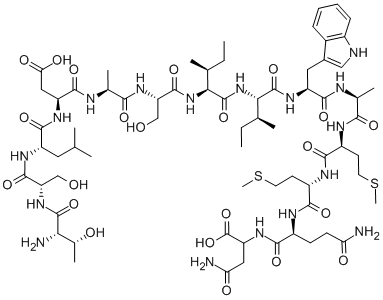 sexual drive and satisfaction, as well as a negative self-image. Non-surgical treatment has been ineffective in producing sustained weight loss among these individuals, and bariatric Oxysophocarpine surgery appears to be the most effective treatment for obesity, particularly among patients with a BMI.40 kg/m2 or those with a BMI.35 kg/m2 and significant obesity-related comorbidities. Dallal et al. reported that obesity-related sexual dysfunction could be reversible through gastric bypass surgery. However, the histologic and functional evaluations are as yet unknown. In 1954, an intestinal bypass operation as a potential treatment for obesity was first reported in a study using a dog model. Since then, many researchers have investigated mechanisms by which gastrointestinal bypass causes weight loss, and many have hypothesized malabsorption, caloric restriction, and gastric restriction to be the cause. However, none of these theories have provided sufficient explanation for clinical findings such as how the Roux-en-Y procedure can restore normal blood glucose levels in 84% of patients with obesity-related T2DM. Since this discovery, the relationship between bariatric surgery and glucose homeostasis has generated a tremendous research interest. Because the intestine itself produces, releases, and controls the endocrine signals of energy metabolism, gut hormones such as GLP-1, PYY, and ghrelin were considered responsible for weight loss and the restoration of glucose homeostasis following gastric bypass surgery. As with other theories, however, these theories based on gastrointestinal hormones remain Folic acid controversial. In our study, the cavernosal tissue in the control and bariatric surgery groups exhibited differences in biochemical and metabolic activities. In this T2DM rat model study, we have ascertained the effect of duodenojejunal bypass surgery on glucose homeostasis. These metabolic functional restorations are the key factors for micro-, macrostructural, and functional recovery. In the control group, the diminished glucose homeostasis led to structural and microvascular damage. The levels of eNOS and nNOS expression were diminished and Rho kinase expression was increased in the diabetic rats that had received the sham operation, compared to the rats that had received bariatric surgery. These resulted in cavernosal smooth muscle atrophy and vascular dysfunction. With these structural alterations, the functional result should be erectile dysfunction. However, in the bariatric surgery group we observed glucose homeostasis recovery that leads to metabolic and biochemical restoration, an increased level of eNOS, nNOS expression, and a diminished level of Rho kinase expression. This microvascular structural restoration leads to a macrostructural recovery, and thus, results in functional recovery. Reactive oxygen radicals are responsible for DNA damage, intracellular damage, apoptosis, and subsequently lead to endothelial fibrosis in the corpus cavernosum. 8-OHdG is an established indicator of DNA oxidative stress. In this study, the 8-OHdG level was lower in the rats that underwent bariatric surgery, indicating that bariatric surgery decreases oxidative stress associated with T2DM in the penile corpus cavernosum.